Fractalized Project Planning: One Hour That Can Save You Hundreds
Problem
AI has unleashed our creative ability to conceive of, build, and deploy new projects and products faster than ever. However, with this new-found great power, comes even greater responsibility to truly think through what we're building, who it is for, the value it provides, and how it's going to work. Chasing that thrill of a fresh idea for a new app or tech project is exhilarating and intoxicating, but can easily become a hastily built road to nowhere, which leaves you mired under a mountain of tech debt and all of the AI tokens in the world won't be able to dig you out.
Solution
This is why we built Fractalized Project/Product Planning. It is a systematic questioning technique that uncovers hidden insights before you write a single line of code or spend your first dollar.
It works by recursively exploring six fundamental questions—Who, What, When, Where, Why, and How—forcing you to fully explore every angle of your idea. Each question reveals dependencies, constraints, and opportunities that you will miss with a typical project plan or even the most comprehensive product requirements document.
This technique is especially effective when taking on projects you don't have extensive experience with. It helps illuminate the blindspots that you didn't know existed, which ultimately saves you dozens of hours of rework from needing to start over due to conflicting requirements or a fundamental misalignment that could have been caught at the outset.
How We're Using It
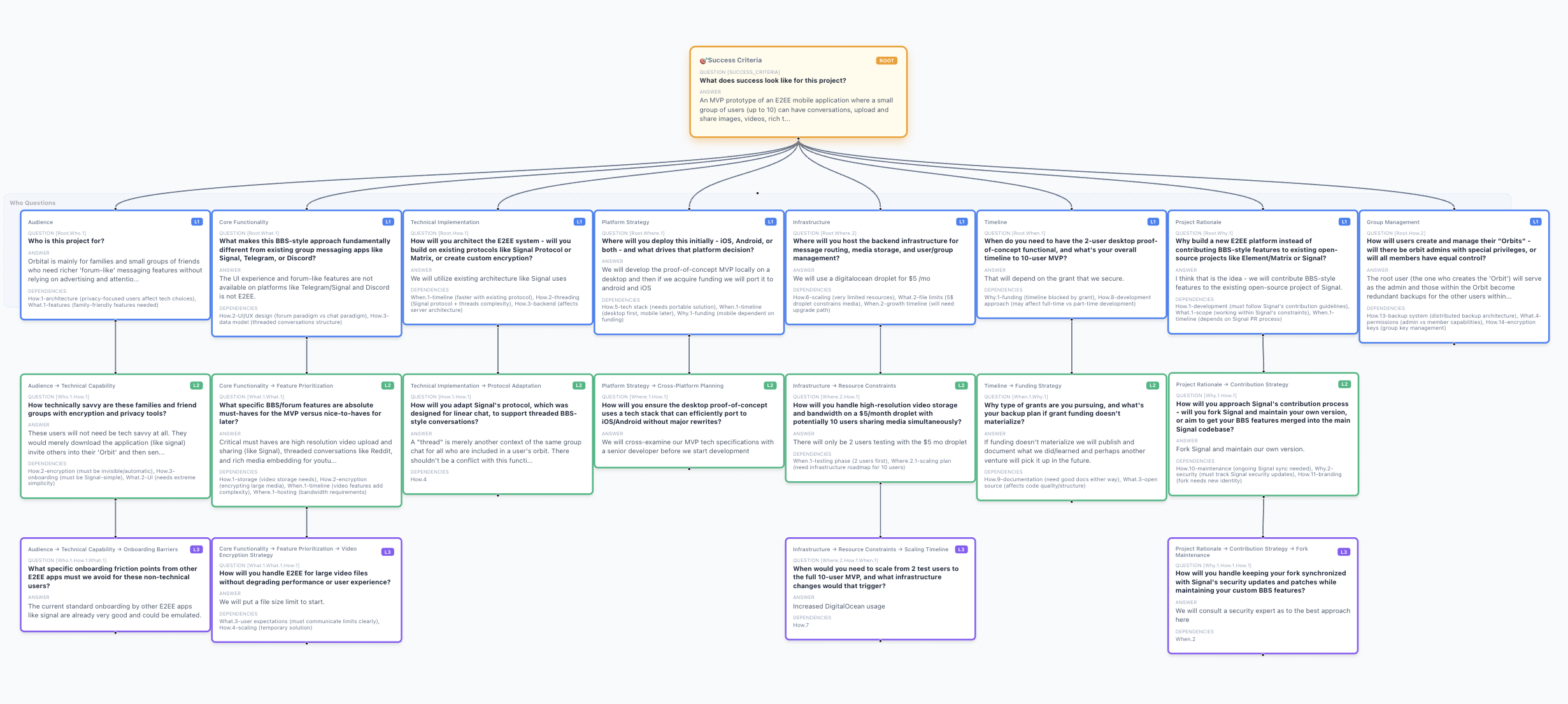
During planning for "Orbital," an encrypted messaging app, the initial concept was to build a BBS-style forum with end-to-end encryption from scratch. Through systematic questioning—particularly "Why build new instead of contributing to existing projects?"—the project pivoted to forking Signal's codebase instead.
This single insight, emerging naturally from the questioning process, saved months of development and avoided reinventing well-established and freely available cryptographic wheels.
Other revelations from the same 60-minute session:
- $5/month hosting creates cascading feature constraints
- Grant dependency affects all timeline decisions
- "Thread" implementation is simpler than anticipated
Each insight emerged organically, not from a predetermined template.
How It Works
The technique uses recursive questioning with a specific format:
- Start broad with critical Who/What/When/Where/Why/How questions
- Branch deeper (L2, L3) only when answers reveal complexity
- Track dependencies as answers affect other project areas
- Allow natural transitions between question types
- Stop when clear - not every branch needs five levels
After 20-30 questions, you'll have:
- A complete decision tree of your project
- Clear dependencies between components
- Identified risks and bottlenecks
- Potential pivots or simplifications
- A realistic view of complexity
Try It Yourself
Use the widget below or the full-size app here
Use the widget above to visualize the plan for your own project. You'll need:
- Your project idea
- Access to an LLM of your choice
- Clear success criteria
- 30-60 minutes of focused time
The technique works because it mimics expert thinking: starting broad, identifying complexity, drilling down where it matters, and—crucially—knowing when to stop. It forces you to confront uncomfortable questions early when pivots are cheap, not later when they're expensive.
---
Use the Prompt Below
Copy the prompt below and be sure to replace the PROJECT description and SUCCESS CRITERIA sections to coincide with your specific use case. When you're done, ask the LLM you're using to output a .md file of your conversation the the templated format. Then upload that .md file into the mind map visualization widget above or go to the full-size app here.
FRACTALIZED PROJECT PLANNER

You are systematically planning a project through recursive questioning that branches from core fundamentals to specific details.

PROJECT: [Your project description]

SUCCESS CRITERIA: [What success looks like]

CORE PROCESS:
1. Start with the most critical of Who/What/When/Where/Why/How for THIS specific project
2. Ask ONE question at a time that directly impacts project success
3. Branch deeper (L2, L3) only when the answer reveals complexity or critical decisions
4. Allow natural type transitions (a Who question can lead to a How question)
5. Track dependencies when an answer affects other areas
6. Stop branching when you have actionable clarity

QUESTION FORMAT:
QUESTION [ParentID.NewType.#]: [Your question]
Breadcrumb: [Plain English path]
Depth: L#
Context: [Why this matters based on previous answers]

ANSWER FORMAT (you complete after user responds):
ANSWER recorded
Dependencies: [NodeIDs affected] or None
Branch Status: [Explore deeper / Sufficient / Move to new root branch]

=== EXAMPLE SEQUENCE ===
QUESTION [Root.Who.1]: Who is the primary audience for this recipe blog?
Breadcrumb: Audience
Depth: L1
Context: Understanding the audience shapes content complexity and style

User: "Busy parents who want healthy 30-minute meals"

ANSWER recorded
Dependencies: [What.1-content type, How.1-recipe format, When.1-posting schedule]
Branch Status: Explore deeper

QUESTION [Who.1.When.1]: When do these busy parents typically look for and cook these meals?
Breadcrumb: Audience → Timing Patterns
Depth: L2
Context: Since they're busy parents, timing affects content format and delivery

User: "Usually Sunday meal prep and weeknight panic at 5pm"

ANSWER recorded
Dependencies: [How.2-content calendar, What.2-recipe categories]
Branch Status: Sufficient

QUESTION [Root.What.1]: What specific recipe categories will address both Sunday prep and weeknight panic scenarios?
Breadcrumb: Content Strategy
Depth: L1
Context: Based on the two distinct use cases identified, content needs dual focus
=== END EXAMPLE ===

Begin with the most critical fundamental question for this specific project.